The Complete Hamster Breeding & Pregnancy Guide

A comprehensive resource for ethical breeding and emergency pregnancy care, ensuring the survival and welfare of mothers and pups.

Understanding Ethical Breeding

Breeding hamsters requires a deep understanding of genetics, significant financial resources, and the space to house multiple solitary adults. It should only be done with the goal of improving the species’ health, lifespan, and temperament.

Preparation
Choosing a Healthy Pair

Both hamsters must be in peak physical condition with a known genetic lineage. Breeding hamsters with unknown genetics can result in fatal deformities (e.g., breeding two hamsters with the “roan” gene produces eyeless, toothless pups). For Russian Dwarfs, ensure the lineage is entirely free of diabetes.

Females should typically be between 4 to 6 months old for their first litter. Breeding a female older than 6 months for the first time is extremely dangerous, as her pelvic bones may have fused, causing fatal birthing complications. Males can generally be bred from 3 months onwards.

Only breed hamsters that are confident, easily handled, and show zero signs of unprovoked cage aggression.

The Process
When They Are Ready
  • Syrians: Female Syrian hamsters go into heat approximately every 4 days, usually in the late evening. When stroked on the lower back, a receptive female will emit a strong musky odor and adopt a rigid mating posture called “lordosis,” freezing in place with her tail raised and back flattened.
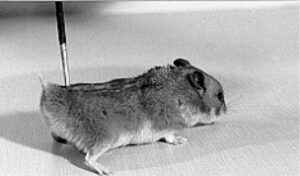
  • Dwarf Species (Roborovski, Campbell, Winter White, Chinese): Dwarf females do not show physical signs of heat that are as obvious as Syrians. They rely more heavily on scent marking and their behavioral reactions when introduced to a male.

Never drop one hamster into another’s established enclosure. Always use a completely neutral space, such as a freshly washed bin cage. Wear thick gloves and keep a piece of cardboard ready to slide between them if a fight breaks out.

Place the female in the neutral space first. Introduce the male. If receptive, the Syrian female will freeze, and the male will mate multiple times over 15 to 30 minutes. Once they lose interest or the female becomes agitated, separate them immediately. Dwarf mating is often quicker and involves more chasing; the male must still be removed prior to the birth.

Emergency Essentials: If Your Hamster Has Already Given Birth

SEPARATE THE MALE/ALL OTHER HAMSTERS!

Hamsters must never be housed together, but if yours have been, you must immediately remove and separate all adults. Dad will try to impregnate mum again swiftly, and mum may well allow this (in dwarf species especially), but will also fight him and others, often to the death. Males play no part in raising pups in nature, and in captivity, they can't leave the female's territory and the results can be catastrophic.

DO NOT DISTURB OR TOUCH MUM OR PUPS

If mum feels threatened, she may kill the pups and/or eat them. This is evolution's efficient way of ensuring that she doesn't waste precious energy feeding young that a predator will get. Do not attempt to count the babies until they emerge from the nest themselves, and do not lift up bedding or items to sneak a look. For TWO WEEKS, providing everything mum needs provides for the babies.

MAKE SURE MUM HAS LOTS OF SOFT BEDDING

Mum’s instinct is to make a deep burrow with a nursery chamber. Provide extra soft nesting material, such as odorless, plain paper tissue. Tear the tissue into small, thin strips before placing it in the enclosure so it’s easier for her to carry and arrange. Add the bedding on the opposite side of the enclosure from the pups, gently and quietly; she will collect the materials herself and build the nest the way she prefers.

PUT THE ENCLOSURE IN THE QUIETEST PLACE

If your hamster usually lives in a busy or noisy part of your home, you will need to gently and carefully move the entire enclosure to your quietest, warmest, least busy space. NEVER remove mum or pups.

REMOVE WHEEL AND SAND

Bathing sand can be harmful to both mum's nursing nipples, and the pups' sensitive hairless skin. Wheels can be dangerous if mum decides to "show" the pups how to use it by taking them for a ride by their scruffs.

OFFER LOTS OF FRESH WATER & EXTRA FOOD

Mum had just used up a lot of her body's resources, and will need more to nurse the pups. Try to only disturb for food once a day. Providing boiled egg (white), boiled chicken, or mealworms everyday (first 10 days) will boost her health and keep her from eating her pups.

  • Pregnant hamsters start to “show” in the second half of their pregnancy, with swelling around the middle of the abdomen showing an “apple shape”. Swelling in the lower abdomen is not a pregnancy and needs veterinary attention.
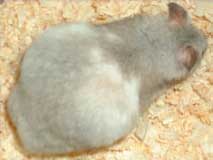
  • Nipples are arranged in a wide horseshoe shape around their underside and may become enlarged or more visible (males do not have nipples).

  • A pregnant hamster will usually attempt to build a nursery chamber. Placid hamsters may suddenly become territorial, and charge or vocalise when even their familiar carer touches or moves things in their home.

  • It is strongly recommended that a potentially pregnant hamster is NOT removed from their familiar enclosure or physically examined, as this is extremely stressful for her.

  • Syrian: Average pregnancy is 16-17 days (up to 21 is common), with an average litter of 8-10 pups.

  • Winter White/Campbell’s Dwarf: Average pregnancy is 18-21 days, average litter size is 3-4. They can become pregnant again within an hour of giving birth. Winter White and Campbell’s are two separate species that have been interbred by humans, and as a result have all kinds of genetic issues to be aware of.

  • Roborovski: Longest pregnancy at 20-22 days, giving birth to 4-6 pups on average. They can “pause” a pregnancy if they have dependent pups or feel unsafe (one gave birth 42 days after exposure!).

  • Chinese: Pregnant for 18-21 days, with an average of 4-6 pups. Extremely fertile with fewer courtship rituals.

Enclosure Prep & Diet Rules

Do not deep clean the enclosure, or mess around with it more than is necessary. Remove the wheel when she starts to show (around 10 days in), and the sand as soon as her nipples start to change. Provide a species-specific, “complete” food of the highest quality available (see HWBD seed mix formula). Avoid offering excessive protein: there’s evidence that this can cause the unborn pups to grow too large for a trouble-free labour and birth, especially for Winter White/Russian dwarf/Campbell’s.

Safe & Unsafe Foods
  • Safe Veggies: Broccoli, Carrot (moderation), Cucumber (moderation), Kale, Spinach, Sweetcorn.

  • Safe Protein: Cooked Chicken (No salt or spices), Cooked Egg (boiled/scrambled), Mealworms, Kitten kibble.

  • Safe Seeds: Chia Seeds, Flax Seeds, Pumpkin seeds, Sunflower Seeds (feed sparingly).

  • Safe Fruits (sparingly for dwarves, remove pips): Apples, Bananas, Blueberries, Strawberries.

  • Unsafe Foods: Chocolate, Packaged meat such as Ham, Raw Potato and Leaves, Kidney Beans.

Timeline of Birth & Growth

Labour & Birth

A hamster going into labour may become agitated, restless and unsettled, and may pant or vocalise. She gives birth to pups one by one. The rejected newborn pup's best chance is to be placed with the others, and this is the ONLY TIME YOU SHOULD INTERVENE. Quietly and carefully, pick the pup up with a warm spoon, making no human contact.

The "Invisible" Stage
0-2 Weeks

Pups are born hairless, with closed eyes and ears, weighing between 0.5g (robos) and 3g (Syrians). They begin to bellycrawl at around 7 days. Mum needs extra protein to regain muscle; cooked plain chicken, edamame beans, cooked egg and dried mealworms will be well received. Porridge is also a great addition. You may hear squeaks, snoring, and little choruses; whatever you hear, you must leave the nest alone!

Emerging & Weaning
2-4 Weeks

From 8 days old the pups will start to eat food that Mum brings back to the nest. By 14 days, they will begin to leave the nest and explore. Pups are typically weaned by 3 weeks of age but Mum can still nurse them until 4 weeks. You can handle pups when they are confidently roaming (around 21 days) using a jug or container. Never mark the pups with any dye or ink, as this is often toxic. You can clean the enclosure at 3+ weeks. Reduce risks of falls, smothering in hides, and boisterous playfighting.

Sexing & Separating
4-6 Weeks

All hamster species have reached the start of puberty by 5 weeks old. Separate siblings into same-sex groups, and mum from them all. Separate mum first so that she isn't distressed by the handling process. Sexing is a two-person job; use a large glass jug to view their underside. Male hamsters won't have visible or enlarged testicles straight away, but they're still fertile. Reliable sexing by anogenital distance isn't 100% clear at 4 weeks, so videoing and reviewing helps.

Solitary Life & Ethical Rehoming

8 Weeks Minimum

NO HAMSTER SHOULD BE REHOMED PRIOR TO 8 WEEKS. This early, secure and settled socialization period is critical to their mental and psychological development. Hamsters must live alone from 8 weeks.

Rehoming Rules

Always ask for a token amount to ensure the adopter can pay for lifelong care and specialist equipment. Ask for pictures of their enclosure with a dated sign. Hamsters are not suitable companions for young children.

You can always list your hamster you want to rehome to our adoption directory. We will make sure that your hamster will get a proper home. Contact us here.